
Norman County Supervision Types
Probation, supervised release, and parole are not interchangeable in Minnesota. Probation comes from a court order. It may follow a stayed sentence, a local jail term, or another disposition, so a Norman County probationer may never have entered state prison. Supervised release is the community portion of many executed Minnesota prison sentences. The person has left prison but remains under Minnesota Department of Corrections jurisdiction. Parole or board release applies chiefly to eligible life, indeterminate, juvenile early-release, and other matters assigned by law to the Supervised Release Board.
The source must match the type. Norman County probation is verified through the court order and Tri-County Community Corrections. A prison release still under state authority is checked in the Minnesota DOC Locator. An eligible board matter may also require the Supervised Release Board schedule or written decision. A hearing date only means a review is scheduled. It does not show that release was granted.
| Type | Who imposes it | Best public check |
|---|---|---|
| Probation | District court | MCRO order and TCCC |
| Supervised release | Part of an executed prison sentence | DOC Locator status and agent |
| Board release or parole | Supervised Release Board in eligible cases | Board record, DOC Locator, and DOC request |
- Discharge
- The end of the sentence or supervision term under the controlling order.
- Revocation
- An order changing supervision after an alleged or proved violation.
- Absconder
- A person alleged to have stopped reporting or left supervision without permission.
- Detainer
- A request by another authority to hold or take custody of a person.
Check Norman County Supervision
Start with the custody path, not a label used in casual speech. A person released from the Norman County 72-Hour Holding Facility or Northwest Regional Corrections Center may be on local probation, may have transferred to DOC, or may have no supervision at all. A DOC detail that reads “Under Supervision” is strong evidence of release from state prison while DOC authority continues. It is not proof that a prior Norman County jail episode ended on the same date.
- Search the DOC Locator by the complete six-digit MNDOC ID when known. A name search uses prefixes, so compare date of birth and ID before opening a result.
- Read the current status and its “as of” date. “Under Supervision,” “Currently with,” Expiration Date, and the linked Agent identify the active state route.
- Use the DOC Community Services Directory. Search Principal Office for current active entries because the directory warns that not every department appears.
- For local probation, check the court order through Minnesota Court Records Online, then contact TCCC to confirm the supervising unit.
- If exact public fields are needed, make a narrow request under Minnesota Statutes section 13.84. Ask for the fact, place, dates, offense, agency, and public changes in supervision.
The official Minnesota DOC Locator shows the search scope and public fields used to begin a state supervision check.
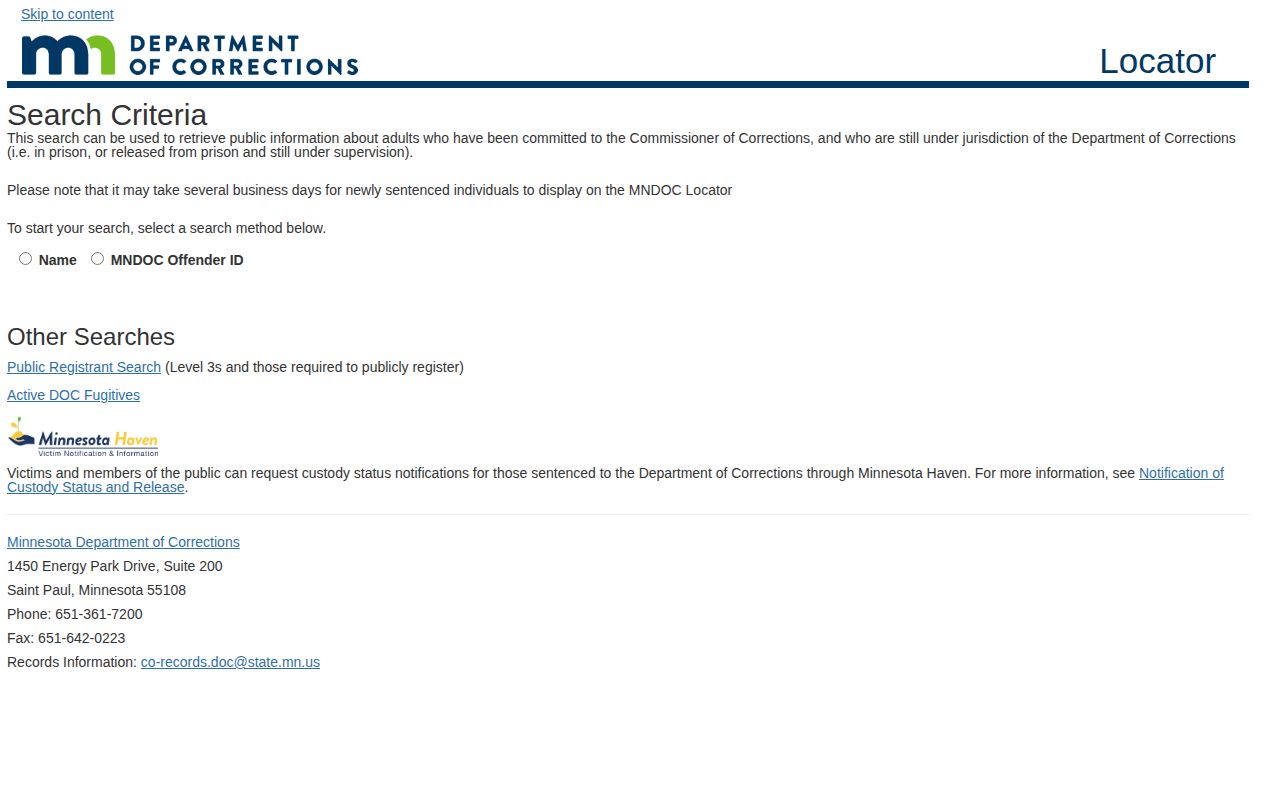
The captured interface documents the lookup route, but the live result and its as-of date must be checked whenever status matters.
A DOC “no results” response has several meanings. The person may be on county probation, fully discharged, outside DOC jurisdiction, newly entered but not yet posted, or listed under a different conviction-associated name. The Norman County court record can establish the ordered disposition. It does not provide the jail’s exact physical exit time. For the release and custody record itself, follow the Norman County search and records path on the released-inmates home page.
Important: “Under Supervision” means the person left prison but has not discharged from Minnesota DOC jurisdiction.
Norman County Regional Supervision
Tri-County Community Corrections is the key local agency for Norman County probation and related community supervision. Its Adult Services program covers Norman, Polk, and Red Lake Counties. Listed functions include probation, supervised release, pretrial services, intensive supervision, transfers, pre-parole investigations, assessments and referrals, testing, crisis counseling, victim services, and registration work. Ask for the correct unit rather than assuming every record is held at the jail.
The public supervision record is useful but bounded. Section 13.84, subdivision 7, identifies public adult court-services facts such as identity, the fact and location of probation or parole, the supervising offense, start and end dates, duration, revocation orders and reasons, conditions and the extent fulfilled, and the supervising agency, unit, or person. Private case notes, assessments, home addresses, treatment details, and unrelated personal facts do not become public merely because supervision exists.
Tri-County Community Corrections
Adult Probation Services
Central probation: 218-470-8101
Chief Probation Officer Jessica Hajicek: 218-470-8123
Official Adult Services page
Call with the person’s full name, case number if known, and a focused question about the public supervising office. Office staff can identify the right route without disclosing protected details. If TCCC does not hold the state case, the DOC Locator’s “Currently with” and Agent fields point to the agency that does.
Note: A supervising office can confirm public status, but the signed court or DOC order controls the legal terms and end date.
Norman County Release Network
Norman County has an unusually connected regional custody and supervision structure. TCCC operates Northwest Regional Corrections Center and also delivers adult probation, supervised-release, pretrial, transfer, and pre-parole services across three counties. NWRCC program staff provide discharge planning, counseling, and other programming. This can make the agency easier to identify, but its units still hold different records.
A jail roster answers whether a person appears on a current custody snapshot. Adult Services addresses the community-supervision side. The court holds the judgment, probation order, and later docket activity. Minnesota DOC holds state-prison sentence computation and supervised-release details. A sound Norman County post-release check uses the source that created each fact instead of treating TCCC as one all-purpose file.
Norman County Wanted Status
A DOC Locator status of “Wanted Fugitive” can mean the person left prison and later became wanted while the active sentence remained under DOC authority. It does not mean supervision ended. Contact the named supervising agency when the public record must be clarified, and use court records for filed warrants or revocation orders. Do not approach or attempt to detain a person based on a web result.
The Minnesota public registrant search is also too narrow to serve as a general supervision lookup. It covers people within specific registration and public-notification rules, not every released person or every registrant. A separate noncompliant listing concerns registration compliance. Neither a hit nor an empty result supplies a universal answer about parole, probation, prison release, or discharge.
Conditions vary with the controlling order. They may address reporting, travel, treatment, contact, testing, or other conduct, but public access does not expose every private detail. A revocation order can identify the reason and change in status. The court or DOC order, not a summary label, establishes the result.
Norman County Parole Hearings
Minnesota’s Supervised Release Board handles eligible life-sentence, indeterminate, juvenile early-release, and related cases within its statutory authority. It is not a routine parole step for every Norman County person serving an ordinary determinate prison term. For a standard determinate case, the DOC Locator’s Anticipated Release Date and supervision status are more useful than a board calendar.
The official life-review schedule shows matters set for consideration, not outcomes. For covered life and indeterminate hearings, section 244.05 requires a decision within 30 days. A matter may result in approval subject to conditions and timing, denial, continued review, or lawful rescission of a prerelease decision. No separate official searchable public decisions database was verified. Request a specific public written decision from the Board or DOC by naming the person, case, and review date.
Eligibility cannot be calculated from the offense name alone. Life-without-release categories, court-set minimums, juvenile provisions, and other rules differ. Use the sentencing judgment, current statute, written Board action, and DOC record together. A hearing date never proves that a Norman County prison release occurred.
Property After Norman County Release
Release logistics can remain unfinished even after custody changes. The NWRCC handbook says stored property is returned at release. Early release of property to a third party requires authorization, the recipient’s photo identification, and a request made 24 hours in advance. Unclaimed property may be disposed of after 90 days, while undelivered commissary has a ten-day pickup window.
Missing facility-issued clothing or bedding can delay release processing. Post-release mail is forwarded to the address supplied by the person or returned. These rules do not establish supervision status, yet they matter when reconnecting after release. Contact NWRCC for the current property process and use the supervision office for reporting obligations. Keeping those questions separate helps each unit answer the part it actually controls.
Norman County Supervision Discharge
Supervision ends through the legal event that controls the case. A probation-discharge order may close court probation. A DOC Expiration Date shows an expected endpoint while the person remains within DOC jurisdiction, but the current record should still be checked for later changes. Board cases follow the Board’s written action and applicable statute. A scheduled board hearing is not a discharge record.
For a historical state discharge that no longer appears in the Locator, ask DOC Central Records at co-records.doc@state.mn.us for the specific release, discharge, or sentence-computation record. Include the full name, MNDOC ID if known, date of birth, court case, and date range. For Norman County probation, request the public supervision fields from TCCC and obtain the filed discharge order from Court Administration.
Minnesota records can also change in public visibility. Expungement generally seals covered records rather than destroying them. An empty remote search can reflect discharge, delayed data, a sealed matter, or a source’s limited scope. Confirm the result with the agency that issued the controlling order.